Setting up a UK limited company in 2026: current fees and the rules that changed
By Mariam Raouf. Published 2026-06-24. 7 min read.
Search for how to set up a UK limited company and you will be told it costs £50. Every comparison site says it. Every formation agent's blog says it. It has not been £50 for a while.
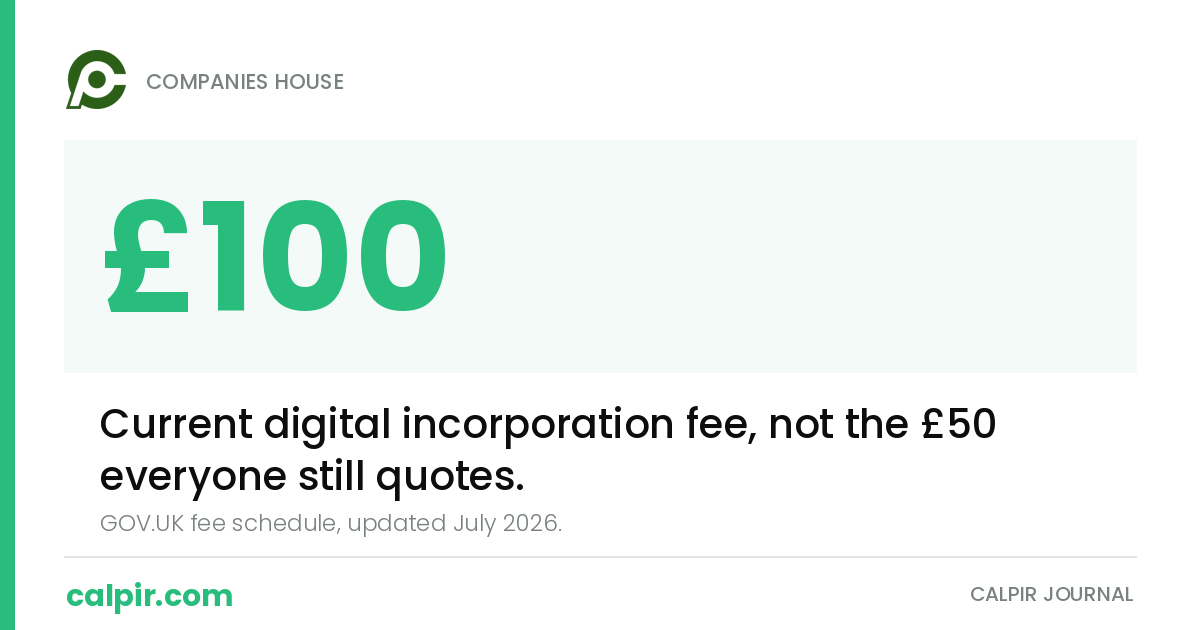
The current digital incorporation fee published by Companies House is £100. The £50 figure everyone still repeats is the May 2024 rate. The confirmation statement is now £50 rather than the £34 that is equally widely quoted. If you budgeted from a blog post, your budget is out by roughly double on both lines.
One thing before we go further. Most people reading Calpir are American, and a UK limited company is not the default answer for you. This is for the case where you are weighing one deliberately: a UK based cofounder, UK customers who want to buy from a UK entity, a platform that requires one. If none of that describes you, our US formation guide is the more useful page.
What it actually costs
| Filing | Digital | Paper |
|---|---|---|
| Incorporation | £100 | £124 |
| Same day incorporation | £156, software filing only | not available |
| Confirmation statement, first in a 12 month period | £50 | £110 |
| Change of name | £20 | £30 |
| Voluntary strike off | £13 | £18 |
Source: Companies House fees, GOV.UK, updated 2 July 2026.
A note on how I am presenting these. GOV.UK does not state a commencement date for the current figures on that page, so I am publishing them as the fees in force as of September 2026 rather than claiming a date on which they changed. If the exact effective date matters, for a filing you made earlier this year say, ask Companies House directly rather than trusting any blog, including this one.
The confirmation statement line catches people out for a second reason. It is £50 for the first one in a 12 month period, so filing an updated statement again inside that window does not cost another £50. An annual charge in practice, not a per filing one.
How to set up a UK limited company, step by step
The sequence is short, and the parts that go wrong are almost never the parts people worry about.
Choose the name and check it is available. Names are checked against the Companies House register at the point of application.
Decide the registered office address. The step with new rules, covered in its own section below because it is now the most common reason an application creates problems later.
Provide a registered email address. Also new, also below.
File the incorporation. Digitally at £100, on paper at £124, or via approved software at £156 for a same day service.
Tell HMRC when the company becomes active. There is a hard deadline on this one and almost nobody mentions it. Details further down.
How long it takes
Online registration is usually completed within 24 hours. Postal registration takes 8 to 10 days, according to GOV.UK's own guidance.
So the paper route costs £24 more and roughly a week and a half. There is no scenario where posting is better unless you cannot file online at all. Same day incorporation exists at £156, but only through filing software rather than the standard web service, which in practice means going through an agent.
The registered office rules changed, and this is where people get caught
The registered office is not a formality any more. Current GOV.UK guidance sets out several requirements that did not all exist a few years ago.
It must be a physical UK address, in the same part of the UK the company is registered in. A company registered in England and Wales needs an address in England or Wales.
It must be an appropriate address. That means an address where post sent to the company would be expected to come to the attention of someone acting for it, and where delivery can be acknowledged. The test is whether mail actually reaches you and can be confirmed.
Royal Mail PO Boxes are no longer permitted. This is the change that catches the most people, because using a PO Box was normal and widely recommended. It is not allowed now.
A registered email address is required, and it is not published on the public register. Worth saying clearly, because people assume providing an email means exposing it.
Failure to maintain a valid registered office address can lead to strike off. That is the company being removed from the register. Not a fine, the end of the company.
So if you were planning to use a mail forwarding service, check that what you are buying meets the appropriate address test and is not a Royal Mail PO Box wearing a nicer name. And if you use a home address, understand that the registered office is public.
The three month rule that costs people money
Once your company is active, you have a deadline that is measured from when you start trading, not from when you incorporated.
GOV.UK is explicit: "You must tell HMRC within 3 months of starting your tax accounting period if your limited company is within the charge of Corporation Tax and is now active." Source.
Three months. From starting the accounting period, not from registration, and the two are often different dates because plenty of companies incorporate and then sit dormant for a while before doing any business. Registering the company at Companies House does not do this for you. It is a separate notification to a separate agency.
This is the single most skipped step in every UK formation guide I have read, and it is the one with a clock on it.
Should an American founder set up a UK limited company at all
Probably not, if you are asking generally. Here is the honest comparison on the numbers alone.
| UK limited company | Typical US LLC | |
|---|---|---|
| Formation cost | £100 digital | $50 in New Mexico to $425 in Nevada |
| Annual filing cost | £50 confirmation statement | $0 in Ohio to $800 a year in California |
| Speed | usually within 24 hours online | varies by state |
| Address requirement | appropriate UK address, no PO Box | registered agent with a physical street address |
Sources: Companies House fees, Delaware fee schedule, California Franchise Tax Board, Wyoming business fees. Checked September 2026.
Costs are broadly comparable and neither side wins decisively, which means cost is not the deciding factor. Anyone telling you a UK company is cheaper, or a US LLC is, is comparing two numbers out of a much longer list.
The reasons that justify a UK entity are structural rather than financial. A UK based cofounder or employees. Customers who are UK businesses and prefer to contract with a UK supplier. A platform or payment provider that requires one. Genuinely operating in the UK rather than incorporating there for optics.
The reason that does not justify it is thinking it will simplify your tax position. Running entities in two countries is a tax question with real consequences in both, one for an accountant qualified in both, not for a blog. Calpir works on both structures regularly, so we have opinions, and none of them are advice about your situation.
If you are choosing between US states instead, the Wyoming, Delaware and New Mexico comparison is the more relevant read.
The short version
Budget £100 rather than £50, file online rather than by post, and treat the registered office requirement as a real decision rather than a box. Then put a reminder in your calendar for the HMRC notification, because that is the deadline with teeth and the one that no formation service handles on your behalf.
If you are American and reading this to work out whether a UK company is worth it, the fees are not the reason to do it or not do it. The reason is whether you genuinely operate there.
At Calpir we build the systems a company needs once it exists, websites, CRM, and the operations layer underneath, on either side of the Atlantic. If you want a view on what to build first, the free assessment will tell you, and our services page covers the rest. For anything touching tax in two countries, talk to an accountant before you talk to me.
Frequently asked questions
How much does it cost to set up a UK limited company in 2026?
£100 to incorporate digitally, £124 on paper, or £156 for a same day service filed through approved software. The confirmation statement afterwards is £50 for the first one in any 12 month period. Those are the current Companies House published figures as of September 2026, not the £50 and £34 that older guides quote.
Why do so many sites still say £50?
Because £50 was the digital incorporation fee set in May 2024, and most formation content was written once and never revisited. Fee pages are boring to maintain and the number changed quietly. Check the GOV.UK fees page directly, which is the primary source and is dated on the page itself.
How long does it take to register a UK company?
Online registration is usually completed within 24 hours. Postal applications take 8 to 10 days. There is also a same day option at £156, available only through filing software rather than the standard online service, so you will usually go through an agent to use it.
Can I use a PO Box as my registered office?
No. Royal Mail PO Boxes are no longer permitted. The registered office must be an appropriate address, meaning post sent there would be expected to reach someone acting for the company and delivery can be acknowledged. Failing to maintain a valid address can lead to the company being struck off.
Do I have to tell HMRC separately after registering?
Yes. Registering at Companies House does not notify HMRC that the company is trading. You must tell HMRC within three months of starting your tax accounting period that the company is within the charge of Corporation Tax and is now active. Three months from starting the period, which is often not the incorporation date.
Is my registered email address public?
No. A registered email address is now required but is not published on the public register. The registered office address is public, which is the one people usually mean to ask about.
Sources
- Companies House fees, GOV.UK, updated 2 July 2026
- GOV.UK, register your company
- GOV.UK, company address rules
- GOV.UK, Corporation Tax trading and non trading
- Delaware Division of Corporations fee schedule
- California Franchise Tax Board, LLC
- Wyoming Secretary of State business fees
- Florida Sunbiz LLC fees
- Nevada Revised Statutes Chapter 86