How to set up a business in 2026: the parts nobody explains properly
By Mariam Raouf. Published 2026-07-02. 8 min read.
In July 2026, Americans filed 578,926 business applications, up 8.1% on June. That gets reported as "578,926 new businesses", which is not what it is, and the difference matters.
A business application in the Census data is an application for an Employer Identification Number. It is a form, not a registered company and not a trading business, and a large share of them never become either. Census separates out high propensity applications, the ones likely to become employer businesses. In July 2026 that was 151,857, roughly 26% of the total.
So here is how to set up a business in 2026 in the order the steps unblock each other, with the real fee or deadline attached to each.
The failure statistic you have been told
You have read that 90% of startups fail. It is everywhere, and it has no basis in any BLS or Census dataset I can find. Here is what the Bureau of Labor Statistics actually publishes:
| Birth cohort, year ended March | Survived 1 year | Survived 5 years | Survived 10 years |
|---|---|---|---|
| 2025 | 77.9% | not yet available | not yet available |
| 2024 | 78.2% | not yet available | not yet available |
| 2020 | 80.9% | 57.2% | not yet available |
| 2015 | 79.6% | 55.4% | 37.4% |
Source: BLS Business Employment Dynamics, Table 7.
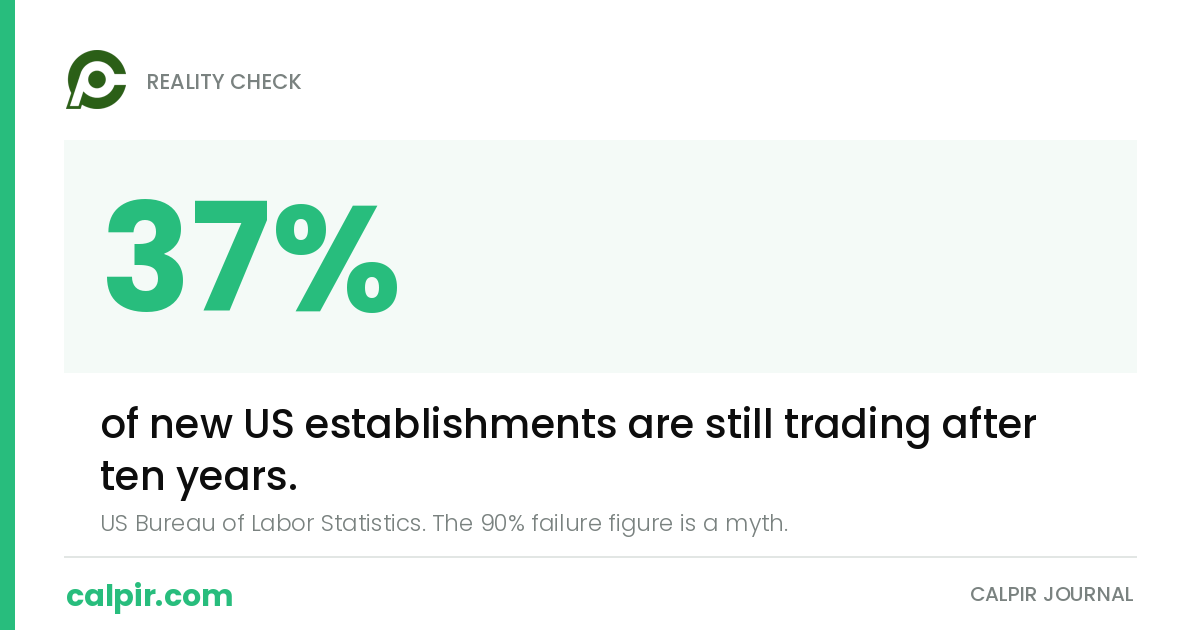
Read across the 2015 row. About one in five establishments do not survive year one, roughly 45% are gone within five years, and about 37% are there at ten. So the defensible number is that around 63% fail within a decade. Bad, but very different from 90%, and BLS notes that survival rates follow a similar path regardless of birth year, so this is stable rather than a pandemic artefact.
Why start here. Because 90% makes setup feel like a lottery ticket, and the real numbers make it what it is, a thing where most survivors did the boring parts.
How to set up a business in 2026, in dependency order
Seven stages, each there because the next will not work without it.
- Decide the structure
- Form the entity with a state
- Get the EIN
- Open the bank account
- Set up how money comes in
- Set up how customers find you and get handled
- Write down how the work gets done
Most guides put the website first because a website is fun and paperwork is not. That costs weeks, because you cannot take a payment into an account you do not have, cannot open the account without the EIN, and cannot get the EIN without the entity.
Stage 1: decide the structure
Three realistic options, and the choice is mostly about who will own it.
LLC. Cheapest, simplest, flexible. The default for most small businesses.
C Corp. Federal rate is a flat 21%, and the SBA is blunt about the cost: "Corporate profits are taxed twice, first, when the company makes a profit, and again when dividends are paid to shareholders." The return is due on the 15th day of the 4th month after year end. Choose this when raising outside investment.
S Corp. An election, made on Form 2553, not a separate entity type. The restrictions are strict: a domestic corporation, no more than 100 shareholders, one class of stock, and shareholders limited to individuals and certain trusts and estates.
Those rules are why an S Corp cannot take venture money. VC funds are usually partnerships or LLCs, so they are not eligible shareholders. Foreign investors are not eligible either, and preferred stock is a second class of stock. Any one of the three ends the conversation.
If you might ever sell, Qualified Small Business Stock relief under 26 U.S.C. 1202 applies to domestic C corporation stock and explicitly not to S corporation stock. For stock issued after 4 July 2025 the gross assets limit rose to $75,000,000 and the holding period became tiered, at 50% relief after three years and 100% after five.
Stage 2: form the entity
Filing fees range from $50 in New Mexico and Colorado to $425 in Nevada, and the annual cost from nothing in Ohio to $800 a year in California. Delaware's annual LLC tax rose to $400 in 2026, which most comparison articles have not caught up with.
The full ten state table is in our guide to choosing between Wyoming, Delaware and New Mexico, with the honest answer about forming out of state, which is that for a business with a physical home it usually costs more.
A registered agent is mandatory everywhere. Physical street address in the state, someone there during business hours to accept legal service. A PO box will not do.
Stage 3: get the EIN
The EIN is free. The IRS says so plainly: "Beware of websites that charge for an EIN. You never have to pay a fee for an EIN."
Timelines, from the IRS instructions:
| Method | Time to receive the EIN |
|---|---|
| Online | Immediate, issued at the end of the session |
| Fax | Generally within 4 business days |
| Approximately 4 weeks | |
| Phone, international applicants | Same call |
Two traps. The online session times out after 15 minutes of inactivity and restarts from the beginning. And if you have no legal residence, principal place of business or principal office in the United States, the tool is closed to you.
The bigger myth is that you need a Social Security Number. You do not. The IRS instructions say to enter "foreign" or N/A on line 7b where the responsible party has no SSN or ITIN and cannot get one. International applicants call 267 941 1099, not toll free, open 6:00 a.m. to 11:00 p.m. Eastern. Full process in getting an EIN without an SSN.
Stage 4: open the bank account
If you are a US person this is ordinary. If not, you have probably been told you need an SSN. You do not.
Under FinCEN's Customer Identification Program rule, 31 CFR 1020.220, a bank may accept from a non US person a taxpayer identification number, a passport number and country of issuance, an alien identification card number, or another government issued document evidencing nationality or residence and bearing a photograph. A passport is legally sufficient. What stops people is bank policy, covered in opening a US bank account as a non resident.
Good news for 2026. FinCEN's final rule of 11 August 2026 permanently removes the requirement for US companies and US persons to report beneficial ownership information under the Corporate Transparency Act. Almost every setup guide still tells you to file a BOI report. One nuance: a foreign company registering in a US state is still a reporting company.
Stage 5: the money side
Invoicing, payments, and the filings that follow money.
If your LLC has a single owner who is not a US person, the expensive one lives here. Form 5472 applies to a foreign owned US disregarded entity with any reportable transaction in the tax year, and that includes amounts paid or received in connection with the formation of the entity, including contributions to it. Funding your own LLC's account counts. The IRS instructions state that a penalty of $25,000 will be assessed on any reporting corporation that fails to file when due, with a further $25,000 for each 30 day period beyond 90 days after notification. Walkthrough in our Form 5472 guide.
Stage 6: the customer side
Now, and only now, the website and CRM.
A site that cannot get an enquiry into somewhere you will actually look is a brochure. Get the capture working before the hero image. Our notes on choosing a CRM go through the tools without pretending one wins, and website development and CRM and sales systems are the service versions.
Stage 7: the operating layer
Write down how the work gets done before you hire anyone to do it.
The least glamorous stage, and the one deciding whether the business can exist without you. Start with the three processes you repeat most. Examples in our post on SOPs for small businesses, and operations and HR is the service version.
What it costs to set up a business in 2026
| Line item | Realistic cost |
|---|---|
| State filing fee | $50 to $425 |
| EIN | $0 |
| Registered agent | annual, varies by provider |
| Annual state cost | $0 in Ohio to $800 in California |
| Website, CRM, operations tooling | the widest variable |
State figures from the fee schedules below. EIN cost from the IRS.
The legal minimum to exist as a company is often under $200. Everything above that is a choice about how fast you move.
Where people actually get stuck
Not on the filing. That is a form and a fee.
They get stuck between stage 4 and stage 5, holding a company that legally exists and cannot take money, and between stage 6 and stage 7, running a business that works only when they personally do everything. Both are ordinary problems with ordinary fixes.
Pick the stage you are stuck at and finish that one.
At Calpir we build stages five through seven for people who would rather run the business than assemble it. The free assessment will tell you which stage you are actually at, which is often not the one people think.
Frequently asked questions
How long does it take to set up a business in 2026?
The entity takes days, depending on the state and whether you expedite. The EIN is immediate online, four business days by fax, or roughly four weeks by mail. Banking is the variable step, from an afternoon to several weeks.
Is the 90% startup failure rate real?
No. It has no BLS or Census basis. The published survival data shows about 78% of new establishments surviving their first year and about 37% surviving to ten, so roughly 63% fail within a decade. Still hard, but a different claim, and nobody sourced the 90%.
Are business applications the same as new businesses?
No, and this is the most common error in the topic. Census business applications are EIN applications, and many never become operating companies. The separate high propensity figure was 151,857 of the 578,926 filed in July 2026.
Do I still need to file a BOI report?
Not if you are a US company or a US person. FinCEN's final rule of 11 August 2026 permanently removed the requirement and is deleting information previously reported by US persons. A foreign company registering in a US state is still a reporting company.
Sources
- US Census Bureau Business Formation Statistics
- BLS Business Employment Dynamics, Table 7
- BLS entrepreneurship and business survival
- IRS Publication 542, corporations
- SBA, choose a business structure
- IRS, S corporations
- 26 U.S.C. 1202, qualified small business stock
- IRS, apply for an EIN online
- IRS instructions for the EIN application
- 31 CFR 1020.220, customer identification programs
- IRS Instructions for Form 5472
- FinCEN, beneficial ownership reporting permanently ended
- Delaware Division of Corporations fee schedule
- California Franchise Tax Board, LLC