What to automate first in a small business
By Mariam Raouf. Published 2026-07-26. 7 min read.
Most people answer the question "what to automate first in a small business" by listing tools. Here is a CRM, here is a scheduler, here is a form builder, go forth. That list is useless because it tells you nothing about which of your processes is ready.
A process is ready when four things are true at once. It happens often. It needs almost no judgement. Somebody has already written it down, or could in twenty minutes. And it is currently failing in a way that a real person notices and complains about.
Miss any one and you will build something nobody uses, or something that quietly breaks and costs more than it saved. Below is the test, six candidates that usually pass it, and an honest list of what to leave alone.
The four part test
High frequency. If it happens twice a year, automating it is a hobby. Weekly is the floor, daily is better. The value comes from repetition, not cleverness.
Low judgement. The steps are the same every time, or vary in ways you can write as a rule. "Send the welcome pack" qualifies. "Decide whether this client is a good fit" does not.
Already written down. Not in someone's head. Written. If you cannot describe the process in numbered steps, you do not have a process, you have a habit, and automating a habit produces chaos at speed. Our SOP examples for a small service business post has templates for this.
Visibly failing. Something drops. Invoices go out late, leads sit unanswered overnight, onboarding emails get missed. If nobody notices the current version failing, nobody will notice the automated version working either.
What small businesses actually use AI for, according to the Census
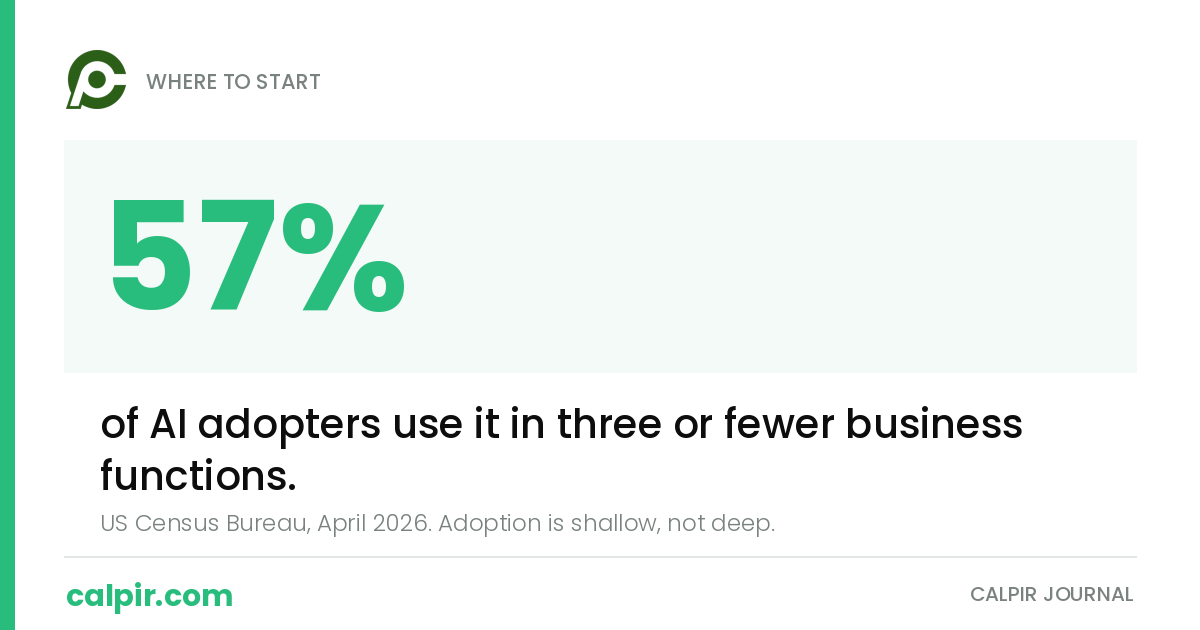
Before picking a candidate, know how shallow real adoption is. The marketing makes it sound like everyone is running fleets of agents. They are not. Census Bureau research published in April 2026 found that about 57% of adopters use AI in three or fewer business functions. Not three or fewer departments transformed. Three or fewer functions touched at all.
| Business function | Share of AI adopting firms using AI there |
|---|---|
| Sales and Marketing | 52% |
| Strategy and Business Development | 45% |
| IT | 41% |
Source: US Census Bureau working paper on AI use in business functions, April 2026.
Two more numbers from the same paper are worth holding onto. Only 2% of firms report AI related employment decreases, and 66% of adopters use AI to augment work rather than replace it. That is the realistic picture. Nobody is firing their operations person. They are getting enquiries answered faster.
A worker level survey looks like it disagrees. The US Chamber of Commerce Foundation and Ipsos found that 50% of small business workers use AI at work, from a probability sample of 1,070 employed adults fielded in May 2026. Both are true. The Census asks a company officer whether the business used AI in producing goods or services. The Chamber asks workers about any use at all. Most small business AI is one employee quietly using a chatbot, which is why only 6% of those workers said they use it for workflow automation. That 6% is roughly the size of the real opportunity.
Six things to automate first in a small business
| Process | What triggers it | What it connects |
|---|---|---|
| Inbound enquiry routing | Form submission or inbox rule | Website form, CRM, Slack or email, calendar |
| New client onboarding | Deal marked won in the CRM | CRM, contract tool, invoicing, shared drive, email |
| Invoice creation and chasing | Job marked complete, or a date | Project tool, invoicing, payments, email |
| Meeting notes to actions | Call recording finishes | Transcription tool, CRM or task tracker |
| Review and referral requests | Job closed plus a delay | CRM, email or SMS, Google Business Profile |
| Weekly reporting pack | Schedule, every Monday | CRM, ads accounts, accounting, a spreadsheet |
Take them in order of how loudly they are failing, not the order listed.
Inbound enquiry routing is the one I would pick first for most service businesses. The trigger is unambiguous, the steps never change, and the failure is visible the moment a lead sits for a day. It also sits in Sales and Marketing, where the Census data says adoption happens.
New client onboarding is the highest value one, and the hardest, because it touches the most systems. Do it second, after you have proved the pattern works.
Meeting notes to actions is where an AI model genuinely earns its keep early, because summarising and extracting structured data from text is what these models are reliably good at.
Weekly reporting is the least glamorous and often the best return, because it replaces a recurring job that a human hates and does badly.
Build the simplest thing that works
The strongest advice on this comes from Anthropic's own engineering team, who build these systems and have no incentive to talk you out of buying more of them. Their guidance is to find "the simplest solution possible, and only increasing complexity when needed", and they warn that "the autonomous nature of agents means higher costs, and the potential for compounding errors".
They also draw a line worth memorising. Workflows are systems where LLMs and tools are orchestrated through predefined code paths. Agents are systems where the model directs its own process.
Almost everything on the candidate list above is a workflow. A form arrives, five things happen in a fixed order. There is no decision for a model to make, so putting one in the middle adds cost, latency and a new way to fail. Reach for an agent when the flexibility is the point, not because agents are what the industry is selling. The cost side of that choice is broken down in our post on how much AI automation costs.
What not to automate first
Anything that needs to be right nearly every time. The tau bench benchmark measures whether an agent completes the same task correctly on all eight attempts, and found that leading function calling agents scored under 25% on that measure in retail scenarios, while succeeding on fewer than half of single attempts. Something that works when you demo it can still fail one run in three. If a wrong output means a wrong invoice, a wrong payment or a lost customer, that process is not first.
Anything customer facing you have not watched run. Build it, then run it in shadow mode, where the output goes to you instead of the customer, for a couple of weeks. You will find things.
Anything not yet written down. Automation encodes a process. If the process only exists as folklore, you will encode three different people's versions of it and discover the conflict in production.
Anything you are about to change. If you are switching CRM next quarter, wait.
What to do this month
Pick one process. Write it down in numbered steps, with a trigger at the top and a definition of done at the bottom. Count how many times it ran last month.
Then build the smallest possible version. Not the one with branching logic for every edge case. The one that handles the eighty percent case and pings a human on anything else.
Watch it for four weeks. Count what it caught and what it missed. Only then decide whether a second one is worth doing. If you want a structured way to pick the right first process, our automation assessment walks through it.
The short version
Automation is a selection decision more than a technology decision. Pick the wrong process and the best tooling produces something nobody trusts. Pick the right one and a dull sequence of connected apps quietly removes a recurring annoyance from your week.
The test is worth repeating because it is all of it. High frequency, low judgement, already written down, visibly failing. If a process fails any of those, it is not first. It might be third.
At Calpir we build these connections for small businesses, and the AI automation page explains how that works. Send me a process you are considering and I will tell you honestly whether it passes the test.
Frequently asked questions
What should a small business automate first?
The process that runs at least weekly, needs no judgement, is already written down in steps, and is currently failing in a way somebody complains about. For most service businesses that is inbound enquiry routing, because the trigger is clear and a slow response is immediately visible. Onboarding is more valuable but touches more systems, so it works better second.
Do I need AI to automate a small business process?
Usually not for the first one. Most small business processes are fixed sequences, and a deterministic workflow that runs the same way every time is cheaper and easier to debug than a model deciding what to do. Anthropic's own guidance is to use the simplest solution that works. Add a model where you need text summarised, classified or extracted.
How many processes should I automate at once?
One. Census data shows most firms that adopt AI touch three or fewer business functions, and those are the ones getting value. Building four automations in a month means debugging four things simultaneously with no baseline to compare against. Ship one, watch it for a month, then decide.
Is automation going to replace my staff?
The Census data says almost never. Only 2% of firms report AI related employment decreases, and 66% of adopters use it to augment work rather than replace it. In a small business the realistic outcome is that the person who was chasing invoices manually now spends that hour on work that needs a human.
What is the most common reason a first automation fails?
The process was not written down properly, so the automation encodes assumptions nobody agreed to. The second most common reason is choosing something customer facing before watching it run in private. Both are avoidable with a fortnight of patience.
Sources
- US Census Bureau, working paper on AI use in business functions, April 2026
- US Census Bureau, Large Firms With at Least 20 Employees Biggest AI Users, May 2026
- US Chamber of Commerce Foundation and Ipsos, Main Street AI Monitor, June 2026
- Anthropic, Building Effective Agents
- Yao et al., tau bench, arXiv:2406.12045