Are AI agents actually replacing SaaS tools, or is that just a good headline
By Mariam Raouf. Published 2026-07-10. 7 min read.
Someone on LinkedIn will tell you this week that your CRM is dead and an agent will do it all. It is a great headline. It is also a claim you can check.
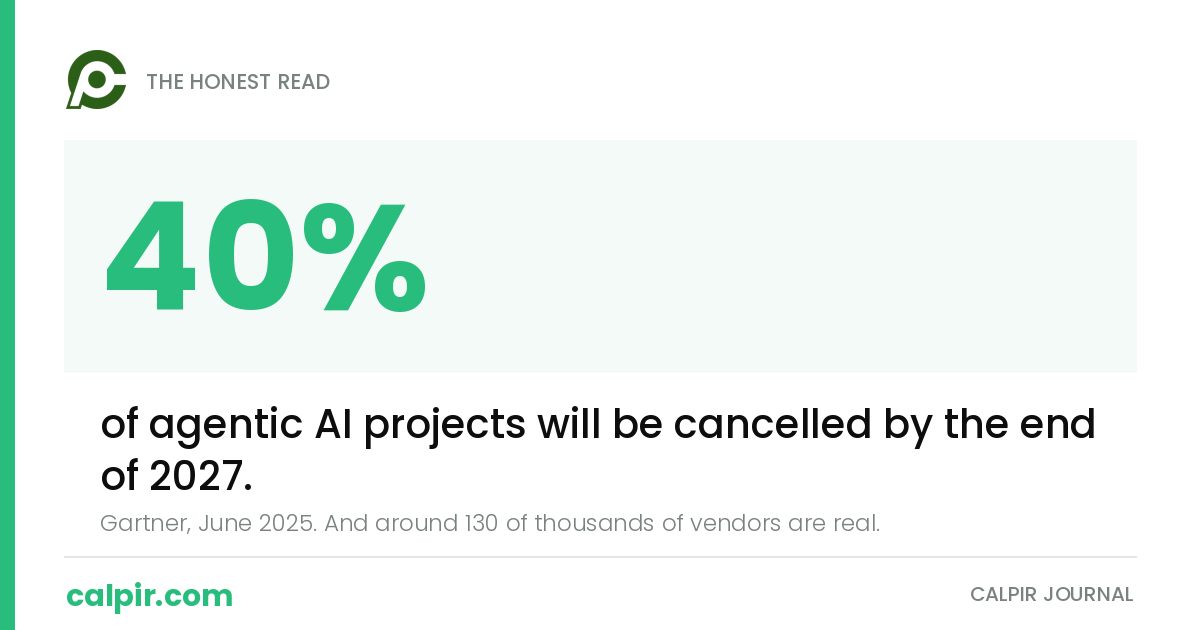
So: are AI agents replacing SaaS? They are replacing specific tasks inside SaaS tools and almost nothing else, and the data is public and fairly blunt. Under a fifth of small US firms use AI at all. Gartner expects more than 40% of agentic AI projects to be cancelled by the end of 2027. And the biggest research lab in the space published a guide telling you to use the simplest thing that works.
What follows is the definition that matters, the four things people call agents, and what the adoption numbers show once you separate the firm from the employee.
What an AI agent actually is, according to the people building them
The most useful definition comes from Anthropic's engineering team, in Building Effective Agents, published December 2024. They split the category in two.
Workflows are "systems where LLMs and tools are orchestrated through predefined code paths." A developer wrote the sequence. The model fills in the parts that need language.
Agents are "systems where LLMs dynamically direct their own processes and tool usage, maintaining control over how they accomplish tasks." Nobody wrote the sequence. The model picks the next step each time.
They put it more plainly elsewhere in the same piece: "Agents are typically just LLMs using tools based on environmental feedback in a loop."
That distinction is the spine of this whole question, because almost everything sold as an agent in 2026 is a workflow. OpenAI's practical guide to building agents draws the same line from the other side: applications that integrate a language model "but don't use them to control workflow execution" are, in their words, "not agents".
Anthropic is also not shy about the tradeoff. "The autonomous nature of agents means higher costs, and the potential for compounding errors." That is the model vendor saying it.
The four things people call agents
Four genuinely different technologies wear one word. Here is the split the primary sources support.
| Who decides the next step | Typical trigger | Failure mode | |
|---|---|---|---|
| Chatbot | Nobody. It answers, it does not execute | Human message | Wrong answer |
| RPA | Pre recorded script, deterministic and rule based | Schedule or event | Breaks when the screen or data shape changes |
| Workflow automation | A developer, via predefined code paths | Event or webhook | Breaks on an unanticipated branch |
| AI agent | The model itself, dynamically, in a loop | A goal | Compounding errors, unpredictable cost |
Sources: Anthropic, Building Effective Agents, UiPath on robotic process automation, IBM on assistants versus agents.
IBM's framing is the quickest way to remember it: "AI assistants are reactive, performing tasks at your request", while "AI agents are primarily proactive." A chatbot in your help widget is not an agent. Neither is a Zap that summarises an email. Both are useful. Neither replaces software.
Are AI agents replacing SaaS tools, or replacing tasks inside them
Software as a service is mostly three things bundled together: a database of your records, a set of workflows around that database, and an interface for humans to look at both.
Agents are currently decent at the third thing and part of the second. They can read a record, draft a reply, classify an enquiry, pull structured data out of a document and put it somewhere. That is real value. It is also the top layer, not the foundation.
The database underneath is not going anywhere, because an agent needs somewhere to write. What actually happens is that the interface gets thinner and the agent does more of the clicking. Your CRM stays. The half hour you spent updating it goes. That is a good outcome and it is not replacement.
What the adoption data actually says
The best source on US business AI adoption is the Census Bureau's Business Trends and Outlook Survey, because it is a real federal survey with a published question, not a vendor poll.
| Measure | Figure | Reference period |
|---|---|---|
| National current AI use, all firms | 19.8% | 3 May 2026 |
| Firms with 250 or more employees | 37% | 3 May 2026 |
| Firms with 100 to 249 employees | 32% | 3 May 2026 |
| Firms with four or fewer employees | Less than 20% | 3 May 2026 |
| Adopters using AI in three or fewer business functions | About 57% | April 2026 working paper |
Sources: US Census Bureau, America Counts, 26 May 2026, Census Bureau working paper on AI use in business functions, April 2026.
Two things jump out. Most firms are not using AI in producing goods or services at all, and small firms showed no significant change between December 2025 and May 2026 while larger firms rose. More revealing, adoption among adopters is shallow: roughly 57% use it in three or fewer business functions, led by sales and marketing at 52%.
That is not a market where software is being replaced. That is a market where a fifth of businesses have started using a new tool for one or two jobs. The same paper notes that AI related employment decreases occur in only 2% of firms, and 66% of adopters use AI to augment rather than replace work.
What the vendor data says, and the phrase "agent washing"
Gartner published two numbers in June 2025 that belong in every conversation about this.
The first: over 40% of agentic AI projects will be cancelled by the end of 2027, "due to escalating costs, unclear business value or inadequate risk controls."
The second should change how you shop. Of the thousands of vendors claiming to sell agentic AI, Gartner estimates only around 130 are genuine. The rest are what Gartner calls agent washing: rebranding assistants, RPA and chatbots. Analyst Anushree Verma put it directly: "Most agentic AI projects right now are early stage experiments or proof of concepts that are mostly driven by hype and are often misapplied."
Roughly 130 real ones out of thousands. If a tool promises to replace a category of software, the base rate says it probably does not do what the homepage says.
The 2029 prediction, and the word doing all the work
The optimistic Gartner number gets quoted constantly, usually wrong. The actual prediction, from March 2025, is that by 2029 agentic AI will autonomously resolve 80% of common customer service issues without human intervention, with a 30% reduction in operational costs.
The load bearing word is common.
Not 80% of customer service issues. Eighty percent of the common ones: password resets, order status checks, refund windows. Exactly the bounded, verifiable, repetitive tasks agents are already reasonable at. The hard tickets, the angry ones, the ones where policy meets judgement, are not in that number. Anyone quoting it as "AI will handle 80% of customer service" has dropped the only word that made it a careful forecast.
If you are actually planning that deployment, our guide to deploying an AI agent for customer support covers what to automate first and what to keep human.
What this means for what you buy this year
Stop asking whether agents will replace your stack. Ask which specific task inside your stack is bounded enough that a wrong answer is cheap and a human sees the output before it matters.
Then check whether it needs an agent at all. Anthropic's guidance is to find "the simplest solution possible, and only increasing complexity when needed". A deterministic workflow that runs identically every time is cheaper, faster and vastly easier to debug, and the right starting point for most businesses. Price it before you commit, because agents loop, which is why AI agent running costs behave differently from ordinary automation billing.
So, are AI agents replacing SaaS or not
The honest read of the data is that we are early. Not that agents are fake, and not that they are about to eat your software. Somewhere in between, which makes for a bad headline and a better plan.
The businesses getting value are doing unglamorous things. They picked one repetitive task, wrapped it in checks, put a person on the output, and left the rest alone. Nobody writes a thread about that. It works.
At Calpir we build AI agents and the plainer automation underneath them, and a decent share of our advice is that the plainer version is enough. If you want someone to look at one process and say honestly which it is, our assessment is where that starts.
Frequently asked questions
Are AI agents replacing SaaS tools in 2026?
No, not at the tool level. They absorb specific tasks inside those tools: drafting, classifying, summarising, data entry. The record system stays, because the agent needs somewhere to read from and write to. Census data shows under 20% of the smallest US firms use AI at all, which is not the profile of a market mid replacement.
What is the difference between an AI agent and workflow automation?
Who decides the next step. Anthropic defines workflows as systems where models and tools run through predefined code paths, and agents as systems where the model directs its own process and tool use. A workflow is predictable and cheap. An agent is flexible and costs more, with a real risk of compounding errors.
How do I tell a real agent vendor from a rebranded chatbot?
Ask what the agent does when its first approach fails. A real agent picks a different tool and tries again. A rebranded workflow errors out. Gartner estimates only about 130 of thousands of agentic AI vendors are genuine, so treat the claim as unproven until a demo shows the model choosing its own path.
Should a small business wait before adopting AI agents?
Not wait, but start narrow. The evidence supports agents on bounded, verifiable tasks where a human reviews the output, and does not yet support long unsupervised chains. Pick one process, run it for a month, and measure it. That is a far better use of a quarter than a platform migration.